ShareThis

Friday, August 17, 2012

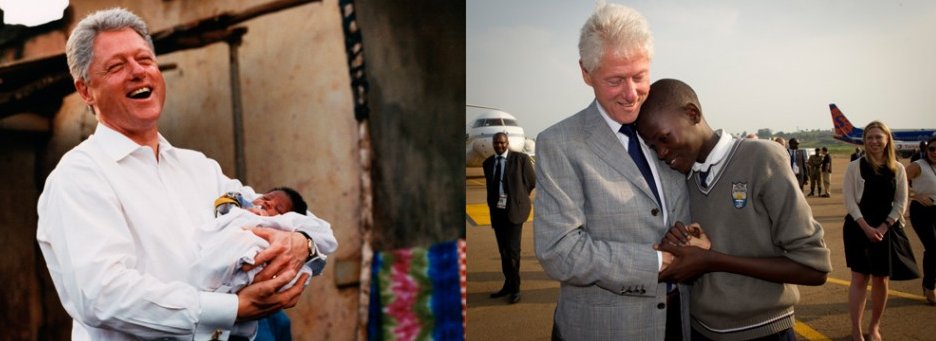
Former US president Bill Clinton Meets Bill Clinton of Uganda, but causes the student to miss his School Exams

The Ugandan newspaper the Daily Monitor reports that the two Bill Clintons met in Entebbe, Uganda last Friday. The teen, whose full name is Master Bill Clinton Kaligani, was airlifted to Entebbe and sat down with Clinton for lunch.


In 1998, then U.S. president Bill Clinton met a baby who was named after him in a village in Uganda.
Now, fourteen years later, the former president was reunited with his "Ugandan son."

However, according to AllAfrica.com, the Ugandan Bill had to miss an exam to make the meeting but the boy was thrilled to meet the man who has made such an impact on his life. How Unfortunate that the Kaligani had to miss an exam just in order to make for the meeting.

The former US president ought to have scheduled his meeting according to the boy's (student's) timetable. How does Clinton expect the boy to become a Doctor, if he has to make him miss his exam

Mmmh! And I do hope the former US president did not joy ride by letting the Ugandan Bill Clinton pay for the Lunch. Lol!


Live Tiger found in a suitcase..ready for its flight!!


The baby tiger pictured above was found hidden among stuffed toy tigers in the suitcase of a woman flying from Iran to Thailand. The cub was gagged to keep him quiet, and drugged to keep him inactive

Source: IFAW


Tuesday, August 7, 2012

12 Bible Verses Every Small Business Owner Needs

I pray that you are inspired by God's word. Your faith in yourself and your business are key to your long-term success. Starting a small business is a spiritual journey. You should pick a verse that will inspire you. I thought it would be helpful to share some of my favorites. Use these bible verses in the good and tough times in your small business.
  1. Deuteronomy 8:18 NIV But remember the LORD your God, for it is he who gives you the ability to produce wealth, and so confirms his covenant, which he swore to your ancestors, as it is today. All of our skills and special talents that we use in our businesses are all given to us by God. He gives us the ability to make money and cut deals. He did it for our parents and mentors and he does it for us too.
  2. Romans 12:2 NIV Do not conform to the pattern of this world, but be transformed by the renewing of your mind. Then you will be able to test and approve what God's will is--his good, pleasing and perfect will. The bible commands us to be innovative in our businesses. We should not ever try to be like anyone else. The world is still waiting on a better mousetrap, and we should never rest on our successes. We must renew ourselves by being lifelong learners and reading constantly.
  3. I Thessalonians 5:16-19 NIV Be joyful always; pray continually; give thanks in all circumstances; this is the will of God for your life. It is important to have a prayerful life as an entrepreneur; it will help you on those days when things do not go your way. You need to have the strength to thank God, even when you do not win that big contract. God protects us when we do not get opportunities that we think we can't survive without. Always be grateful.
  4. Proverbs 16:18 NIV Pride goes before destruction, a haughty spirit before a fall. Many entrepreneurs struggle with pride. Do not be afraid to tell clients or employees that you do not know the answer. Try to diffuse any issues with truth and by taking full responsibility for fixing the problem. Never let your ego get in the way of doing what's in the best interest of your business.
  5. II Corinthians 9:8 NIV And God is able to bless you abundantly, so that in all things at all times, having all that you need, you will abound in every good work. God always delivers to us what we need in order to do our best work. Sometimes he sends a check we need just in time, and other times he sends us creativity to find the best solution to our challenges. Trust in the Lord at all times.
  6. II Timothy 1:7 NIV For the Spirit God gave us does not make us timid, but gives us power, love and self-discipline. Fear is the enemy of entrepreneurship. God wants us to go out with the power he gives us to pursue our ideas in business.
  7. Hebrews 12:11 NIV No discipline seems pleasant at the time, but painful. Later on, however, it produces a harvest of righteousness and peace for those who have been trained by it. You must be fiscally disciplined in business. You cannot put all your hard work at risk by not being focused on your big picture goals and your monthly sales goals. It is painful at times, but it will produce quite a harvest.
  8. I Corinthians 9:24 NIV Do you not know that in a race all the runners run, but only one gets the prize? Run in such a way as to get the prize. Running a business is hard. It's a marathon not a sprint. There will be plenty of stumbling blocks in your way. Everyone trips and falls while running this race, but winners get up faster than everyone else. You must do what you need to do to win your race.
  9. Mark 5:36 NIV Overhearing what they said, Jesus told them, "Don't be afraid; just believe." There will be times when you are the only person who believes in your business dream. Don't be afraid. Believe in yourself and your business idea.
  10. Ecclesiastes 11:4 AMP He who observes the wind [and waits for all conditions to be favorable] will not sow, and he who regards the clouds will not reap. You must be willing to make decisions in your small business. No one is going to come along and do it for you. Make hard decisions quickly, so you can move on to doing the work needed to help your customers.
  11. Proverbs 11:14 NIRV Without the guidance of good leaders a nation falls. But many good advisers can save it. It is critical to have a kitchen cabinet of advisors for your small business. Your business will not survive on your experience alone. Pull together four to five people who are invested in your success. The group should include an existing entrepreneur, a customer, a mentor, a lawyer and a accountant. Seek out a mastermind group or peer to peer mentoring program to help as well.
  12. Philippians 4:13 NKJV I can do all things through Christ who strengthens me. Whenever you struggle with your self-confidence read this bible verse to yourself. There will be times in your business when you need to force yourself to stretch beyond what you think is possible. You can do it. I believe in you.
Do you have any other bible verses that inspire you? Please share.

By Melinda Emerson'

Sunday, July 22, 2012

Gays dangerous than terrorists, says Bishop

By Patrick Beja

The gay movement in Kenya is posing greater threat to Christianity than terrorism.

Mombasa Anglican Church of Kenya Bishop Julius Kalu told a congregation including Gachoka MP Mutava Musyimi that Christians are confronted by “the enemies of the Church” mainly homosexuals and lesbians and terrorism was a lesser threat.

“Our greatest fear as Church should not be the grenade attacks, but the new teachings like same sex marriages,” Kalu said, urging Christians to be “spiritually fully armed” to confront the challenges. Kalu has been out of the country for about two months during which the debate on gay sex unions has raged across Coast Province where the practice is prevalent.

In April, a grenade attack on Christians killed one worshipper in Mombasa and on July 1, armed men massacred 17 people including a Muslim policeman in a hail of bullets on two churches in Garissa.

Big enemies
On Sunday, Kalu and Musyimi said Christians are now living in fear after the attacks and are not keen to attend Sunday service.

Kalu said terror attacks and the crusade for gay unions are twin challenges the church must confront.
He said church attendance has dropped in recent times.

“The congregation does not close eyes in prayer for fear of grenade attacks,” Kalu said during a Sunday sermon at ACK Memorial Cathedral, on Sunday. The clergyman said the Church should be more worried about the new liberal teachings allowing same sex marriages.

Kalu said the gay movement has popularised a new moral logic that is threatening to cripple the Church by introducing “unacceptable teachings” in the name of freedom of worship and association and asked Christians to stand up against the “unholy wave”.

“Christians must be fully armed spiritually as it is only divine intervention that will enable the country overcome these challenges,” Kalu said.

 “The Church is at war with enemies of the faith,” Kalu said. The enemies are the people who wanted to change the Christian doctrine.

Source

Case that could reverse gains in war against HIV

By Dann Okoth Kenya and the rest of the developing world is staring a drugs procurement crisis in the face after a multi-national drugs manufacturer moved to court to stop the production of generic medicines by Indian drugs companies.

India is often called the ‘pharmacy of the developing world’ because it produces affordable generic versions of medicines that are used the world over.

More than 80 per cent of the antiretroviral medicines (ARVs) used by organisations involved in HIV and Aids programmes in Kenya come from producers of generics based in India, just as 80 per cent of the ARVs purchased with donor funds globally come from India.

Deathly blow
But if Novartis Pharmaceutical Corporation of Switzerland succeeds in its suit lodged at India’s Supreme Court and whose hearing started on July 10 — it could see prices of essential medicines such as ARVs and cancer drugs skyrocket by more 1,200 per cent — dealing a deathly blow to cancer patients and some 500,000 people in Kenya already on life-sustaining HIV treatment.

 “It would be a disaster,” declares Jennifer Cohn of Medecins Sans Frontieres’ (doctors without borders). “More than 80 per cent of the ARVs used by MSF in its HIV and Aids treatment programmes in Kenya come from producers of generics based in India, we also rely on Indian generics for malaria and tuberculosis treatments a change in the patent laws and hence tougher rules on generics production would be devastating,” she adds.

India became the key producer of affordable medicines because until 2005, the country did not grant patents on medicines, allowing generic manufacturers to freely produce more affordable versions of medicines patented elsewhere.

Fierce competition among producers drove prices down dramatically – whereas ARVs for one person per year cost US$10,000 in 2000, today, they cost just less than one per cent of that figure.

India had to start granting patents for medicines in 2005 because of its obligations as a member of the World Trade Organisation. This means that price-busting competition between generic and originator drug producers will be blocked for drugs that receive patents – for example, for several newer medicines to treat HIV and Aids.  

Patent law
When designing its patent law, however, India decided only drugs that show an improved therapeutic effect over existing ones deserve patents. This part of the law – ‘Section 3d’ – intends to prevent companies from continually extending their 20-year drug patents by making minor changes or improvements – a process called ‘evergreening’.

Along these lines, the Indian patent examiner in 2006 rejected the patent that Swiss pharmaceutical company Novartis sought for the leukemia drug Imatinib mesylate (marketed as Glivec), because it was based on a compound that already existed.

Novartis claims that Imanitib mesylate has 30 per cent increase in bioavailability — the body’s ability to absorb the drug — and should therefore deserve a patent under the terms of ‘increased efficacy’.
In response to its drug patent being rejected, Novartis took the Indian government to court in 2006, not only challenging the rejection of its patent, but also the part of India’s law, Section 3(d,) that formed the basis of the decision.

Lower the bar
By challenging the interpretation of section 3(d), Novartis is seeking to lower the bar on patentability in India and force the country to grant more patents. Indeed if Section 3d were overturned, it would mean patenting would become much more widespread in India, severely limiting the production of more affordable generics.

The protracted legal battle saw Novartis file a case in the Madras High Court in 2006 challenging the constitutionality of section 3d. However, in 2007 they lost in the High Court in Chennai which, in a landmark decision, decided to uphold the constitutionality of Section 3d of India’s Patents Act.
The company was also unsuccessful in its appeal before the Intellectual property Appellate Board (IPAB) in June 2009 to overturn the patent rejection of Imanitib mesylate.

However, having never given up Novartis again brought a new case to India’s Supreme Court (the county’s highest judicial authority) trying to attack and weaken the interpretation of Section 3d.
A narrow or a broad interpretation is likely to have a significant impact on the patents regime in India. What the court decides will then be applied to any subsequent application for any patent for any drug.

After a series of false starts and delays throughout 2011 and 2012, final arguments started on July 10 in India’s Supreme Court in New Delhi with stakeholders in the health and pharmaceutical sectors crossing their fingers.

Friday, July 20, 2012

Free General, Eye, Obstetric and Gynecology Surgeries offered by Consultant Surgeons from USA

Coptic Hospital is pleased to inform you that from 25th July 2012 - 4th August 2012 we will have the pleasure of having Consultant Surgeons coming from the United States of America. The Consultant surgeons will perform General, eye, Obstetric and Gynecology Surgeries. The consultations fee is Kshs.1200. There will be No surgeon fee charged for all the surgeries that will be performed. Among the surgeries that will be performed by the surgeons are: Obstetrics and Gynaecology Surgeries; Both Laparoscopic and Open Surgeries; Cancer and Advanced Cancer Cases; Hysterectomy and Myomectomy; Ovarian Diseases; Eye Surgeries; Comprehensive Eye Check-up; Cataract Surgery; Glaucoma Surgery among others; General Surgeries; Both Laparoscopic and Open Surgeries; Gall bladder stones; Appendicectomy; Hernias; Gastric & Abdomino-pelvic operations; Thyroidectomy; Mastectomy; Booking and Screening is ongoing. For more information and Booking, Kindly contact us on: 0735-408903, 0739642699 and 0735558862 E-mail: coptichospital@copticmission.org. Irene Atim Coptic Hospital Marketing & Customer Relations Officer Tel: 2724737/2725856. Fax 2725771 Cell. 0739-642699

Thursday, July 19, 2012

Kenya stocks at 1-year high, shilling flat

By Beatrice Gachenge NAIROBI (Reuters) - The Kenyan stock market rose 1 percent to a year high on Thursday, as investors anticipated positive results at the beginning of the corporate earnings period, while the shilling traded flat, supported by tax payments. On the Nairobi Securities Exchange, the main NSE 20-Share index rose to 3,825.93 points, a level last seen on July 21 2011. "The earnings season has kicked off and what can be seen, is guys taking positions," said Samora Kariuki, an analyst at NIC Securities. The country's No. 2 cement manufacturer, Athi River Mining, was the top gainer of the main index, rising 8.8 percent to 198 shillings, while beer maker East African Breweries rose 1.3 percent to 227 shillings. On the foreign exchange market at the 1300 GMT close, the shilling was at 84.10/20 to the dollar, barely moved from Thursday's close of 84.05/25. "(Shilling) Tax payments went through and that tightened the market," said Chris Muiga, a trader at Kenya Commercial Bank, adding that that caused the central bank to stay out of the repurchase agreement market for first time this week. Traders, who had expected money supply of 6 billion shillings from maturing repos of various durations in the session, said payment of value added taxes due on Friday, had seen companies withdraw money from banks, reducing excess supply of shilling. The central bank has regularly drained excess shillings from the market this year through seven-day, 14-day, 21-day and 28 day repurchase agreements, underpinning the currency, which has strengthened by 1 percent against the dollar so far this year. In the last eight sessions, the bank has absorbed 24.73 billion shillings. Commercial banks have shunned the debt market in favour of repos after yields on government paper fell as the central bank cut key lending rates. On Thursday, yields on Kenya's 91-day Treasury bill rose to 12.929 percent at in an oversubscribed auction, from 12.001 percent previously. The bank said it received bills worth 4.2 billion shillings for the 3 billion shillings worth of debt on offer, a 140 percent subscription rate. It accepted bids worth 2.9 billion shillings. The yields were still well below last year's rates, which reached about 20 percent. Traders had anticipated that the central bank would push liquidity back to the debt market, after months of low subscription rate, due to low yield. Ignatius Chicha, head of markets at Citibank said the central bank was likely to push liquidity back to the debt market by propping up yields to converge with repo rates, probably at 13 percent and by dropping repo rates. In the debt market, government bonds worth 1.06 billion shillings were traded, down from 1.94 billion shillings previously, with most activity on the 12-year infrastructure bond at a yield of 12.35 percent. Source

Nairobi: Rage as husband meets wife in lodging

By Allan Olingo A married couple busted each other when they bumped into each other at the same lodging in Mlolongo town on the Nairobi-Mombasa highway. The little town, which is just a collection of shops and pubs spread on both sides of the highway, is popular with amorous track drivers and married men and women with secrets to hide. According to Salma, an eyewitness in Mlolongo, husband and wife separately hooked up with their respective clandestine lovers a fortnight ago. “They both checked into the same guest house and proceeded to their respective rooms with their clandestine lovers in tow. But hours later, hell broke loose,” Salma offers. Apparently that evening, the guesthouse experienced power outages and as the woman came out of the shower, the lights went out. Wrapped in a towel, she walked to the main reception to enquire what was a miss. But in a twist of fate, “Her husband also came out in a pair of shorts and an unbuttoned shirt and headed straight to the reception to for the same reason,” says Salma. Scream Forgetting that each was guilty, they both demanded to know what the other was doing at the lodge before throwing caution to the wind and wrestling each other to the ground. “I just saw the woman scream and grab her husband who slapped her hard out of fury,” Salma reports. “The lovers who were still in the room were attracted by the loud confrontation only to find man and wife tearing into each other. They both quickly slipped through the door and disappeared in the darkness as the couple beat the hell out of each other,” Salma says. ”You lied to me that you would be at the project site this evening supervising the construction of our house,” the woman shouted at her husband who was also trying to get answers from her. Apparently, the woman has been secretly entertaining her young lover, not knowing that the husband also frequented the same lodging with a clandestine lover. The couples were thrown out of the lodging by the management as curious onlookers enjoyed the free evening drama. More

Ethiopian PM in Critical Condition

European media are reporting that Ethiopia's longtime Prime Minister Meles Zenawi is hospitalized in critical condition, contrary to statements by the government. News reports say the prime minister is hospitalized at Saint Luc Hospital in Brussels. The hospital on Wednesday declined to say if Mr. Meles is there. In interviews with VOA, government officials and a former ruling party leader confirmed the prime minister is sick. But they denied reports that the 57-year-old leader is gravely ill. The officials did not indicate the nature of Mr. Meles' illness. An official with the Ethiopian Embassy in Kenya said Mr. Meles is “a little bit sick” and “exhausted,” but added Prime Minister Meles will be back at work soon. Mr. Meles' friend and former ruling party leader, Sibhat Nega, told VOA the prime minister will be back in Ethiopia within a week. He has not been seen in public for at least two weeks. The government had scheduled a news conference Wednesday afternoon, but it was cancelled without explanation. Nega said the government has been functioning normally during the prime minister's absence. The parliament passed the prime minister's budget on Monday. Nega said if anything happens to the prime minister, the parliament will choose a new leader after the ruling party presents its candidate. All but one of the members of Ethiopia's Parliament are part of the ruling party TPLF. More

Wednesday, July 18, 2012

Merkel: Circumcision Ban Makes Germany ‘Laughing Stock’

Chancellor Angela Merkel REUTERS Chancellor Angela Merkel has warned that Germany could become a laughing stock if it fails to overturn a district court ban on circumcision that has enraged Jews and Muslims, reports Reuters. Merkel's government has already criticised the Cologne court ruling and promised a new law to protect the right to circumcise male infants, but the conservative leader's strong comments underline how sensitive Germany is to charges of intolerance because of its Nazi past. "I do not want Germany to be the only country in the world where Jews cannot practise their rituals. Otherwise we will become a laughing stock," the Bild daily quoted Merkel as telling a closed meeting of her Christian Democrats (CDU). Joerg van Essen, parliamentary floor leader of Merkel's junior coalition partner the Free Democrats, told the Financial Times Deutschland newspaper that the new law would be introduced in the autumn. The main political parties represented in Germany's parliament were negotiating the text of a resolution late on Tuesday that would exempt from punishment circumcision of under-age boys, parliamentary sources told Reuters. The parties want to pass the resolution on Thursday when the lower house, the Bundestag, interrupts its summer recess to vote on a bailout for Spanish banks. The Cologne court, ruling in the case of a Muslim boy who suffered bleeding after circumcision, said the practice inflicted bodily harm and should not be carried out on young boys, but could be practised on older males who give consent. This is not acceptable under Jewish religious practice, which requires boys to be circumcised from eight days old, nor for many Muslims, for whom the age of circumcision varies according to family, country and branch of Islam. Jewish and Muslim groups have branded the court ruling an attack on their religious freedom and Jewish leaders say it could even threaten the continued existence of their community in Germany - a disturbing claim for a country still haunted by the Nazis' murder of 6 million European Jews in the Holocaust. But the court ruling has drawn support from some, including Britain's Secular Medical Forum, which has written to Merkel urging her to resist pressure to make non-consensual circumcision lawful. "We are shocked that religious groups deny the harm (caused by circumcision) and at the distorted and disingenuous claims made by those opposing the court's decision, wrongly suggesting that it is an indication of anti-Semitism," the chairman of the Secular Medical Forum, Dr. Antony Lempert, said in the letter. "We urge you not to let such emotional blackmail persuade you to change the law or criticise the court's decision. As it stands, the court's decision ensures that today's children will be free to grow up to make their own decisions," it said. Echoing such comments, Ronald Goldman, head of the U.S.-based Jewish Circumcision Resource Center, which opposes the practice, cited studies he said show that circumcision causes considerable pain and trauma.

Lawmaker: Give Germans subsidy to visit Greece

A German lawmaker is suggesting giving holidaymakers a subsidy to visit Greece and other ailing southern European economies. The Associated Press Berlin A German lawmaker is suggesting giving holidaymakers a subsidy to visit Greece and other ailing southern European economies. Erwin Lotter of the Free Democrats says a government-sponsored vacation voucher would help boost the economies of the struggling countries, while helping to lift the mood in Germany where rainy weather has dampened public spirits this summer. The idea floated by the lawmaker has been enthusiastically reported by German media, but seems unlikely to gain wider traction in Parliament, which is currently on its summer break. Germany, the richest economy in the 17-country eurozone, has to pay proportionately more than others in Europe's bailouts.

Monday, March 12, 2012

THE RAILA ODINGA SECRETARIAT - Press Release on the Coming General Election

THE RAILA ODINGA SECRETARIAT

Monday, March 12, 2012

Press Release on the Coming General Election


1. The next General Election in Kenya will be a referendum on the rule of law – the chance to choose between the rule of law and impunity, between reform and reversal of the gains of the past two decades, between anarchy and order.

2. Kenyans participated in a democratic election on 27 December 2007. The election was subsequently compromised.

3. Some forces with a selfish agenda of their own, which included settling scores that had nothing to do with the elections, took advantage of the ensuing protest against this disenfranchisement of the Kenyan electorate. This was a repeat of similar events in 1991-92 and in 1997. In 2008, more than 1,300 Kenyans were killed, hundreds of thousands were forcefully renditioned and thousands suffered all manner of indignity, classified in the international system as crimes against humanity.

4. The victims were Kenyan citizens. They were not occupying forces from some foreign country, whose killing and eviction might have been cause for heroism and celebration. The matter was then supposed to pass quietly away, as in 1992 and 1997, and to wait for another election and another wave of crimes against innocent citizens.

5. The Grand Coalition Government was established to restore the country to normalcy and shepherd institutional reforms. Everyone said, “Never again.” But not everyone has been co-operative. The beneficiaries of the 2008 injustice have shown they will stop at nothing to frustrate reform and justice.

6. It is this spirit of impunity that frustrated efforts to establish a local tribunal to deal with post-election violence. Parliament was mobilised to defeat the Constitutional amendment that sought to do this, with the main perpetrators cunningly creating the false impression that they sought real justice, and could only achieve it through the ICC. The reality is that they did not wish the matter to be addressed at all – locally or otherwise.

7. The same people shouting then, “Don’t be vague, let us go to The Hague,” are the ones now demonising the ICC. They seek to kill two birds with one stone – dragging the Prime Minister and other innocent parties into their self-inflicted woes, and at the same time making political capital out of the ICC matter.

8. The ICC has unfortunately now become an election issue. But since it IS an election issue, let it now be known that the coming elections will also be a referendum on impunity. The time has come when every one of us must stand up to be counted. Either you are for the rule of law, or you are for impunity. It can’t be both. A choice must be made.

9. The cases before the ICC did not arise out of thin air. They are the outcome of circumstances where Kenyans were killed, forcefully evicted and otherwise dehumanised. They are also the outcome of a systematic and lawful investigation, which the Republic of Kenya is lawfully party to. At the end of that investigation and subsequent court hearings, charges have been raised against those the ICC considers should be called upon to answer for the lowest moment in Kenya’s national history.

10. A lawful process having thus been followed, the Kenyan citizens before the ICC should respect the rule of law. They should seek to defend themselves in the impending trial. If they are innocent, as they have frequently professed at charged public rallies, the court will no doubt acquit them. No public petulance on their part can substitute for the court process. Nor can forged documents and the besmirching of innocent persons’ reputations assist them.

11. It is clear that the present posturing against the ICC, complete with the weaving in of the PM’s name and that of the British Government, is a dress rehearsal for non-cooperation with the ICC. It is clear that the foundation is being laid for the accused to refuse to attend trials of the cases against them.

12. In the past, election-time atrocities have gone unaddressed. People are therefore angry that, this time, things are different. They cannot understand why it should not be business as usual. To try to change that, they are feverishly mobilising people to stand on the side of impunity. They have put impunity on the election agenda. It appears they would like to see Kenya burn again.

13. It is up to each Kenyan, therefore, to search his or her soul and decide where they stand. The choice is between the law and impunity.

14. Finally, the lie is being sold that the Prime Minister is a beneficiary of post-election violence. In fact he was the greatest loser. In the interests of peace, he accepted being denied his rightful position as the elected President of Kenya.

15. The real beneficiaries of post-election violence are only too evident. They include those currently in the process of returning property acquired in areas where post-election violence victims were known to have been dispossessed of their land. Now these beneficiaries are rushing to return the land, in order to evade court processes. What greater admission of guilt could there be?

Signed

The Raila Odinga Secretariat
12 march 2012

Read more: http://jukwaa.proboards.com/index.cgi?board=general&action=display&thread=6700&page=1#ixzz1ovdu6ibl

Thursday, March 1, 2012

Maryland Governor to sign gay marriage legislation

ANNAPOLIS, Md. (AP) — Gov. Martin O'Malley will make Maryland the eighth state to legalize gay marriage when he signs a bill passed by the General Assembly.

O'Malley is expected to sign the legislation, which he sponsored, Thursday, though same-sex ceremonies cannot be performed until January 2013.

Gay marriage supporters assume they'll have another hurdle to jump as the law is expected to be petitioned to referendum in November.

Gay marriage opponents are prepared to collect the nearly 56,000 signatures needed to put the measure on the ballot and are expected to rely heavily on churchgoers who oppose same-sex marriage as a matter of faith, to reach that goal.

Organizers say they hope to collect nearly double the required number of signatures to ensure enough are validated by the state elections board.

Gays flee as irate residents storm Likoni seminar

A mob on Thursday stormed the venue of a meeting of homosexuals, scattering the delegates.

About 30 participants scampered from the Likoni CDF Youth Empowerment and Library Centre through the back when about 100 youth led by religious leaders and village elders forced their into the venue.

Five Coast gay leaders, however, were not so lucky as the youths blocked the escape route and seized them.

They were held captive in the building for three hours as residents bayed for their blood.

The five were saved by Likoni police boss Abagarro Guyo and district officer Moses Ouma who ordered the seminar closed.

The five were bundled into a private car and whisked away under tight security.

“Everybody is ordered to vacate these premises. The seminar is terminated immediately and the place closed,” said Mr Guyo.

Sheikh Amir Zani of the Muzadhalfa mosque described the seminar as illegal, ungodly and unacceptable. He threatened to mobilise the community to cane the gays if they organised such a meeting again.

“The government should stop this or we will act as a community,” Sheikh Zani declared.

Mombasa Network for Human Rights organising secretary Ali Kigarimbwe accused the organisers of denigrating the youth centre.

Sauti ya Likoni lobby group chairman Hamisi Hassan Ng’anzi said residents were shocked that such a seminar could be held in their midst.

“Many workshops of this kind have been held, purportedly to impact safe sex skills to the youth but they are actually business ventures.

“Why is drug abuse on the rise? These workshops don’t have any meaning,” he said.

A village elder, Mr Daniel Baridi, said all seminars at the centre should be vetted and approved by community leaders.

“We established this centre to help our youth but it is being abused. We will not allow such activities,” he said.

But the Ministry of Youth and Sports district officer, Mr David Ogal, defended the organisers of the seminar and accused residents of misunderstanding their aims.

“Here we are dealing with very vital education to vulnerable groups, including drug users, commercial sex workers, gays and others.

“We are offering peer and HIV/Aids education to the youth because they are at the highest risk of infection,” he told the press.

Mr Ogal said the ministry’s job was to help impart life skills to the youth and vulnerable groups whose HIV infection is twice that of other groups.

“I am a youth officer and charged with this responsibility. The gay community, like other groups, approached us and requested to be educated on safe sex.

“They have a right to safe sex. By doing this, we are not promoting homosexuality but imparting knowledge.

“There is a lot of social discrimination and stigma about the issue and we as a society must fight it,” he said.

The seminar participants were aged between 20 and 30, said the officer, adding that his ministry would make youth funds available to all groups as they had a right.

The seminar was organised and sponsored by the Kenya NGO Consortium and Constitutional Aids Control Council, which Mr Ogal said paid them a daily allowance of Sh1,000 “for lunch and transport” for each participant.

Source: Daily Nation

Wednesday, September 21, 2011

Chinese condoms too small for South Africans


JOHANNESBURG, Sep 16 – A South African court has blocked the government from buying 11 million Chinese condoms, saying they are too small, a newspaper reported on Friday.

The finance ministry had awarded a contract to a firm called Siqamba Medical, which planned to buy the Phoenurse condoms from China, the Beeld newspaper said.

A rival firm, Sekunjalo Investments Corporation, turned to the High Court in Pretoria after losing the bid, arguing that their condoms were 20 percent larger than the Chinese ones.

Judge Sulet Potterill blocked the deal with Siqamba, ruling that the condoms were too small, made from the wrong material, and were not approved by the World Health Organisation, the paper said.

South Africa has more HIV infections than any country in the world, with 5.38 million of its 50 million people carrying the virus.

Read More here

Tuesday, May 31, 2011

Statement of the Prosecutor on the Situation in Kenya

Luis Moreno‐Ocampo
Prosecutor of the International Criminal Court


On Monday (31st May, 2011) a team from the Office of the Prosecutor will be in Kenya to discuss protection of witnesses with Kenyan authorities.

We will asses not just the specific protection program, but will also want to
understand the current position of the Government in relation with the Post Electoral
Violence.

On 5 November 2009, President Kibaki and Prime Minister Odinga stated their commitment to cooperate with the Court. We received strong cooperation, but
since we announced the names of the 6 suspects we have seen a shift in position:
high ranking members of the government are misrepresenting ICC efforts to do
justice for the victims as an attack against Kenyan sovereignty.

They are pursuing regional and political campaigns to stop the case. Not only is
this sending the wrong signal, but it is also promoting a growing climate of fear
that is intimidating potential witnesses and ultimately undermining national and
international investigations.

Our Office is doing what we promised to do: Justice for the victims. It was in the
point 4 of the Agenda. Everyone agreed on the need to clarify the problem before the
next election.

My question to the Kenyan government is this: does the government of Kenya
want justice for the victims? We need an unequivocal answer, an answer that
Kenyans and the world could understand. Is the government of Kenya
protecting witnesses or protecting the suspects from investigation?
That is the question.

Wednesday, May 25, 2011

Harold Camping reschedules "rapture" for October

California preacher says his apocalyptic prophecy was misunderstood, not wrong, and the end is coming in 5 months.

As crestfallen followers of a California preacher who foresaw the world's end strained to find meaning in their lives, Harold Camping revised his apocalyptic prophecy, saying he was off by five months and the Earth actually will be obliterated on Oct. 21.

Camping, who predicted that 200 million Christians would be taken to heaven Saturday before global cataclysm struck the planet, said Monday that he felt so terrible when his doomsday message did not come true that he left home and took refuge in a motel with his wife. His independent ministry, Family Radio International, spent millions — some of it from donations made by followers — on more than 5,000 billboards and 20 recreational vehicles plastered with the Judgment Day message.


Follower Jeff Hopkins also spent a good deal of his own retirement savings on gas money to power his car so people would see its ominous lighted sign showcasing Camping's May 21 warning. As the appointed day drew nearer, Hopkins started making the 100-mile round trip from Long Island to New York City twice a day, spending at least $15 on gas each trip.

"I've been mocked and scoffed and cursed at and I've been through a lot with this lighted sign on top of my car," said Hopkins, 52, a former television producer who lives in Great River, New York. "I was doing what I've been instructed to do through the Bible, but now I've been stymied. It's like getting slapped in the face."

Camping, who made a special appearance before the press at the Oakland headquarters of the media empire Monday evening, apologized for not having the dates "worked out as accurately as I could have." Through chatting with a friend over what he acknowledged was a very difficult weekend, the light dawned on him that instead of the biblical Rapture in which the faithful would be swept up to the heavens, May 21 had instead been a "spiritual" Judgment Day, which places the entire world under Christ's judgment, he said.

The globe will be completely destroyed in five months, he said, when the apocalypse comes. But because God's judgment and salvation were completed on Saturday, there's no point in continuing to warn people about it, so his network will now just play Christian music and programs until the final end on Oct. 21.

"We've always said May 21 was the day, but we didn't understand altogether the spiritual meaning," he said. "The fact is there is only one kind of people who will ascend into heaven ... if God has saved them they're going to be caught up."

It's not the first time the 89-year-old retired civil engineer has been dismissed by the Christian mainstream and has been forced to explain when his prediction didn't come to pass. Camping also prophesized the Apocalypse would come in 1994, but said later that didn't happen then because of a mathematical error.

Monday, rather than give his normal daily broadcast, Camping took questions as a part of his show, "Open Forum," which transmits his biblical interpretations via the group's radio stations, TV channels, satellite broadcasts and website.

Camping's hands shook slightly as he pinned his microphone to his lapel, and as he clutched a worn Bible he spoke in a quivery monotone about some listeners' earthly concerns after giving away possessions in expectation of the Rapture.

Family Radio would never tell anyone what they should do with their belongings, and those who had fewer would cope, Camping said.

"We're not in the business of financial advice," he said. "We're in the business of telling people there's someone who you can maybe talk to, maybe pray to, and that's God."

But he also said that he wouldn't give away all his possessions ahead of Oct 21.

"I still have to live in a house, I still have to drive a car," he said. "What would be the value of that? If it is Judgment Day why would I give it away?"

Apocalyptic thinking has always been part of American religious life and popular culture. Teachings about the end of the world vary dramatically — even within faith traditions — about how they will occur.

Still, the overwhelming majority of Christians reject the idea that the exact date or time of Jesus' return can be predicted.

Tim LaHaye, co-author of the best-selling "Left Behind" novels about the end times, recently called Camping's prediction "not only bizarre but 100 percent wrong!" He cited the Bible verse Matthew 24:36, "but about that day or hour no one knows" except God.

"While it may be in the near future, many signs of our times certainly indicate so, but anyone who thinks they `know' the day and the hour is flat out wrong," LaHaye wrote on his website, leftbehind.com.

Signs of disappointment also were evident online, where groups that had confidently predicted the Rapture — and, in some cases, had spent money to help spread the word through advertisements — took tentative steps to re-establish Internet presences in the face of widespread mockery.

The Pennsylvania-based group eBible Fellowship still has a website with images of May 21 billboards all over the world, but its Twitter feed has changed over from the increasingly confident predictions before the date to circumspect Bible verses that seem to speak to the confusion and hurt many members likely feel.

Camping offered no clues about Family Radio's finances Monday, saying he could not estimate how much had been spent on getting out his prediction nor how much money the nonprofit had taken in as a result. In 2009, the nonprofit reported in IRS filings that it received $18.3 million in donations, and had assets of more than $104 million, including $34 million in stocks or other publicly traded securities.

Josh Ocasion, who works the teleprompter during Camping's live broadcasts in the group's threadbare studio sandwiched between an auto shop and a palm reader's business, said he enjoyed the production work but he had never fully believed the May 21 prophecy would come true.

"I thought he would show some more human decency in admitting he made a mistake," he said. "We didn't really see that."

Source: CBS
Thursday, May 12, 2011

One in three Africans is now middle class, report finds

Findings challenge view of continent as a place of famine and poverty


One in three Africans is middle class, a rising group of consumers to rival those of China and India, researchers have found (pdf).

Record numbers of people in Africa own houses and cars, use mobile phones and the internet and send their children to private schools and foreign universities, according to the African Development Bank.

Mthuli Ncube, the bank's chief economist, said the findings should challenge long-held perceptions of Africa as a continent of famine, poverty and hopelessness.

"Hey you know what, the world please wake up, this is a phenomenon in Africa that we've not spent a lot of time thinking about," Ncube said. "There is a middle class that is driven by specific factors such as education and we should change our view and work with this group to create a new Africa and make sure Africa realises its full potential."

Ncube said the study used an absolute definition of middle class, meaning people who spend between $2 and $20 a day, which he believed was appropriate given the cost of living for Africa's nearly 1 billion people.

The study found that, by last year, Africa's middle class had risen to about 34% of the continent's population, or about 313m people – up from around 111m (26%) in 1980 and 196m (27%) in 2000.

The growth rate of the middle class over the past 30 years was about 3.1%, slightly faster than that of the total population. Tunisia, Morocco and Egypt had proportionately the biggest middle classes in Africa, while Liberia, Burundi and Rwanda had the smallest.

The Africa middle classes are more likely to have salaried jobs or own small businesses. They tend not to rely entirely on public health services, seeking more expensive medical care. The middle classes tend to have fewer children and spend more on their nutrition and schooling.

Sales of fridges, TVs and mobile phones have surged in virtually every African country in recent years, the report said. Possession of cars and motorcycles in Ghana, for example, has gone up by 81% in the past five years.

"They own houses and they account for the bulk of housing ownership," Ncube said. "They own cars – people are driving cars in Lagos, in Kampala, in Harare, in Ouagadougou – it's the same middle class. You can even see it in the consumption of petrol. The bulk of them are consuming ICT services and mobile telephony, although the poor are also consumers of mobile telephone services.. They would also send their children to school, preferably private schools, but also schools outside the continent. The same class is sending their children to universities outside their home country, in South Africa, in Australia, in Canada, naturally Europe – France is a bigger absorber from the French-speaking countries – and the US."

The middle class was responsible for at least half of Africa's GDP of $1.6tn, he added. The trend reflected years of sustained economic growth, with sub-Saharan Africa projected at 5.5% this year.

"This has implications," Ncube said. "How should the rest of the world engage with Africa, given this middle class? I think it means that those who want to invest should take the opportunity and look for partners within Africa to invest jointly with."

The focus of aid and development assistance would also have to change in the next 10 to 15 years, he argued. "It will have to concentrate less on the bottom of the pyramid and move to the middle, which means it has to be supportive of private sector initiatives, which then are the way middle class people conduct their lives."

Africa has a relatively young population and has seen millions migrate from rural areas to cities, where shopping malls with designer labels and smart coffee shops are springing up across the continent. Ncube acknowledged that a widening, internet-literate middle class could pose a threat to autocratic leaders, as seen in Egypt and Tunisia.

"The middle class is a source of democracy in Africa in a sense that they are custodians of democracy. They are the people who are educated, they know how to vote, they know what they want, they've got interests to protect. Supporting this class in a way also helps institution building in Africa.

But the research found that poverty remains deeply entrenched, with 61% of Africa's population living on less than $2 a day. An estimated 21% earn only enough to spend $2 to $4 a day, leaving about 180 million people vulnerable to economic shocks that could knock them out of the new middle class.

At the top of the pyramid, an elite of about 100,000 Africans had a collective net worth of 60% of the continent's gross domestic product in 2008, the report said.

Source: The Guardian

Monday, April 18, 2011

Polio: The plight of 40 year old who has lived in confinement as an outcast

Mr. Wawire who has been living in confinement for 30 years now.

KAKAMEGA COUNTY: FOR the last 30 years Reuben Wawire has never enjoyed sunrays.

His crime?

He has been incapacitated by a paralysis he suffered in 1980 that has rendered him immobile.

Under the guise of culture, his family members shunned him and locked him in a tiny dungeon like room in an abandoned house away from the rest.

Born in 1974, a healthy baby boy in Makhukhuni village of Matete district, Wawire suffered from polio that left him in the current state.

Efforts by family members to have him fully recover failed and was taken back home and confined for all this period.

A look at Wawire would easily force rivulets of tears roll down his cheeks. At 37 he looks a 2 or 3 year old suffering from debilitating effects of malnutrition.

A good samaritan Mrs. Beatrice Nafula helps to hold Mr. Wawire for a photo.

His abode sends a chill along the spine. Resembling a chicken house and unclean, nobody would imagine that a human being and not an animal has been able to survive in such environment for all this period.

A Good Samaritan and church official Beatrice Nafula who has been occasionally taking care of Wawire revealed that he has been confined in an abandoned house formerly inhabited by the late grandmother.

“As church members we have to visit him, change his clothing and carry him out to enjoy a little sun light”, she said adding that if that is not done he will remain indoors.


Ms. Nafula trys to cover Wawire with a mosquito net, under the rack where it has been his home .

She added that Wawire is fed by well-wishers who in turn donate food and other needs.

Efforts to convince other members of the family to take him in have failed adding that they have branded a bad omen to their community.

“Only the late grandmother Sarah Siekunja used to take care but since she passed on last year his condition was deteriorating for the worse,” Nafula observed pointing out that it was now important for the government to step in and bail him out.

She said it was important for the community to be sensitized on the rights of the physically handicapped so that they are not discriminated.


Source: WestFM

Friday, April 15, 2011

PNU Vs ODM - Prof. Kagwanja Vs. Miguna Migua

The two advisors to the two principals in Kenya, namely Kibaki and ODM, debate on Ocampo 6 and the ICC process.

Watch for yourself and decide who the winner is.